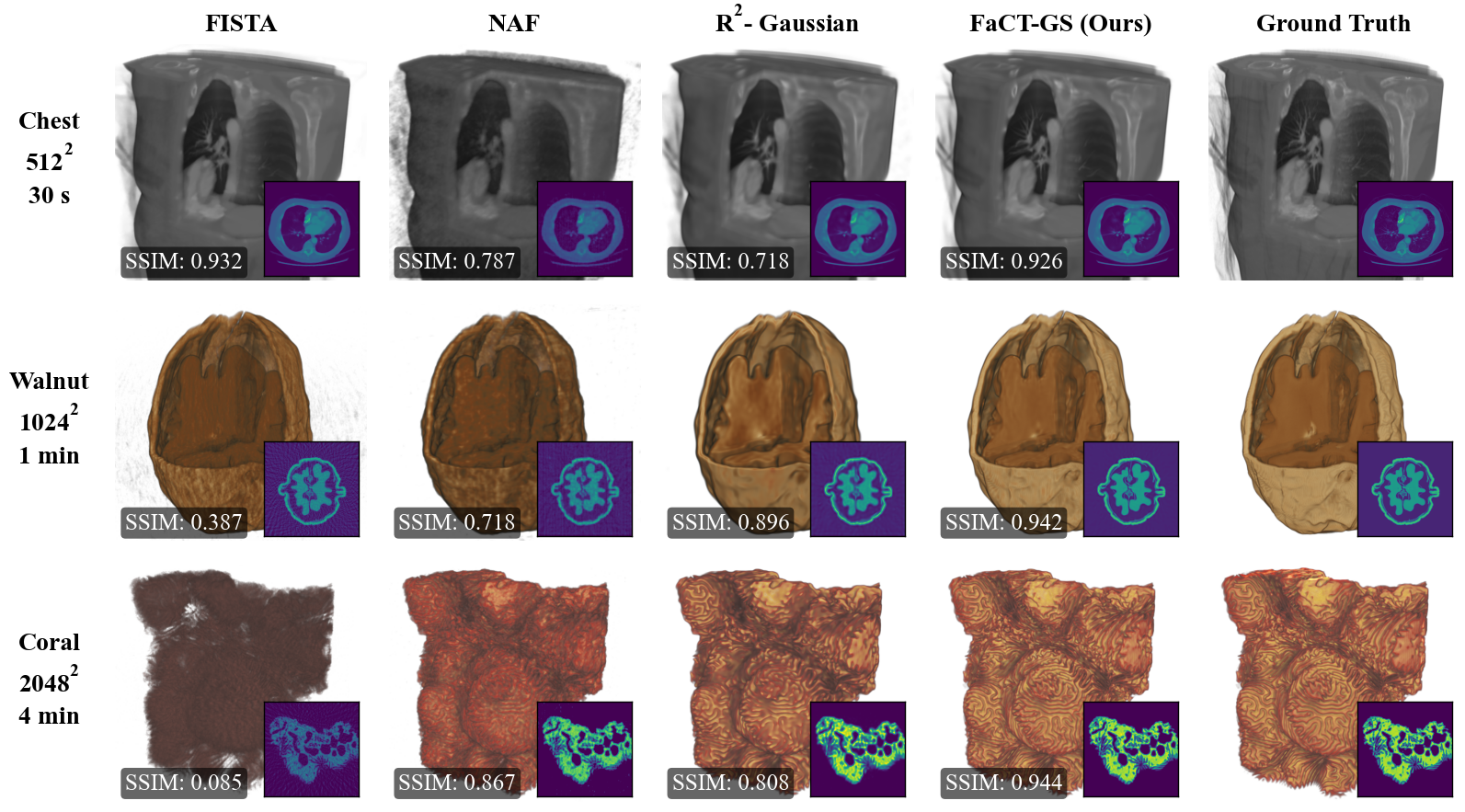
Reconstruction results of select baselines and FaCT-GS given a fixed time for a certain problem size. FaCT-GS provides superior CT reconstruction capabilities and scales exceptionally well with increasing projection size.
Abstract
Gaussian Splatting (GS) has emerged as a dominating technique for image rendering and has quickly been adapted for the X-ray Computed Tomography (CT) reconstruction task. However, despite being on par or better than many of its predecessors, the benefits of GS are typically not substantial enough to motivate a transition from well-established reconstruction algorithms. This paper addresses the most significant remaining limitations of the GS-based approach by introducing FaCT-GS, a framework for fast and flexible CT reconstruction. Enabled by an in-depth optimization of the voxelization and rasterization pipelines, our new method is significantly faster than its predecessors and scales well with projection and output volume size. Furthermore, the improved voxelization enables rapid fitting of Gaussians to pre-existing volumes, which can serve as a prior for warm-starting the reconstruction, or simply as an alternative, compressed representation. FaCT-GS is over 4x faster than the State of the Art GS CT reconstruction on standard 512x512 projections, and over 13x faster on 2k projections.
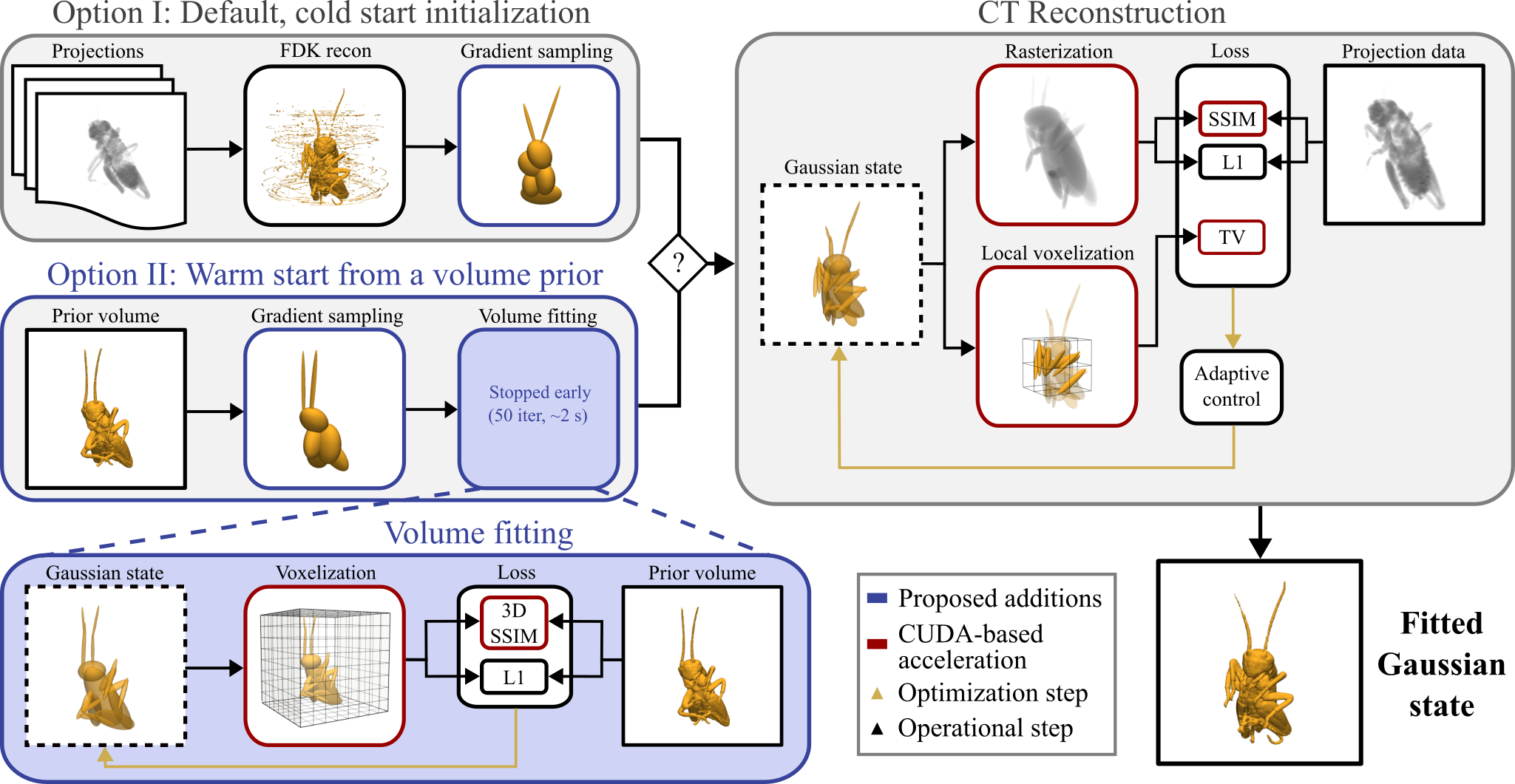
FaCT-GS optimization pipeline. We propose two initialization schemes: one, based on the gradient of the FDK reconstruction from collected projections, and one based on the Gaussians fitted directly to a prior volume. We accelerate the core components of the pipeline: rasterization, voxelization, and compute-intensive loss functions.
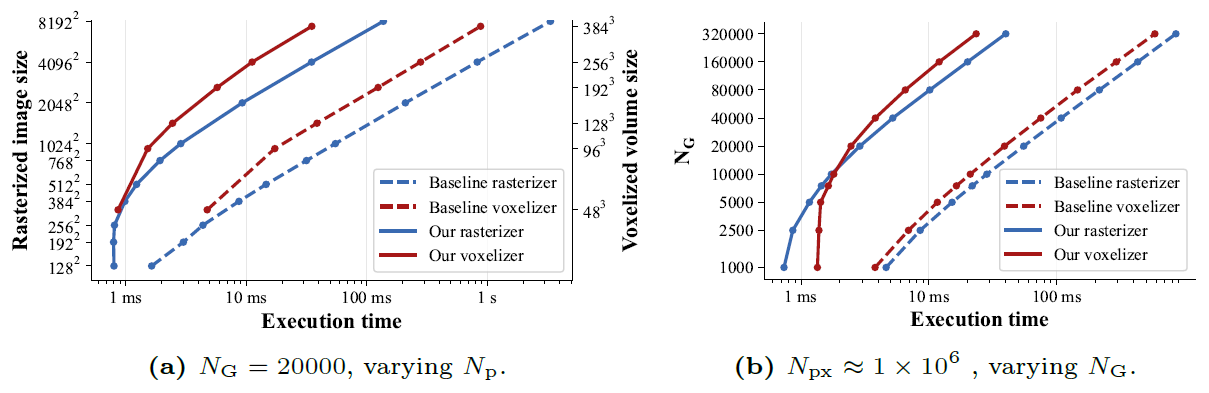
The main impact on performance is enabled by the acceleration of the rasterization and voxelization components. Borrowing from established solutions (Taiming 3DGS, StopThePop, etc.), and designing further CT-specific acceleration, we manage to significantly reduce the execution time, especially for large volumes and projections. For example, a baseline rasterizer needs 210 ms to process a 2k image, while ours completes the same task in 9.3 ms. N_G - number of Gaussians, N_px - number of pixels.
Structural analysis
We test our method on a collection of real and synthetic reconstruction tasks from the R2-Gaussian dataset, comparing to algebraic methods: SIRT and FISTA, NeRF-based methods: IntraTomo and NAF, and the previous State of the Art GS-based method: R2-Gaussian. We further explore the scaling capability, reporting the execution time needed to reconstruct volumes of increasing projection/volume size.
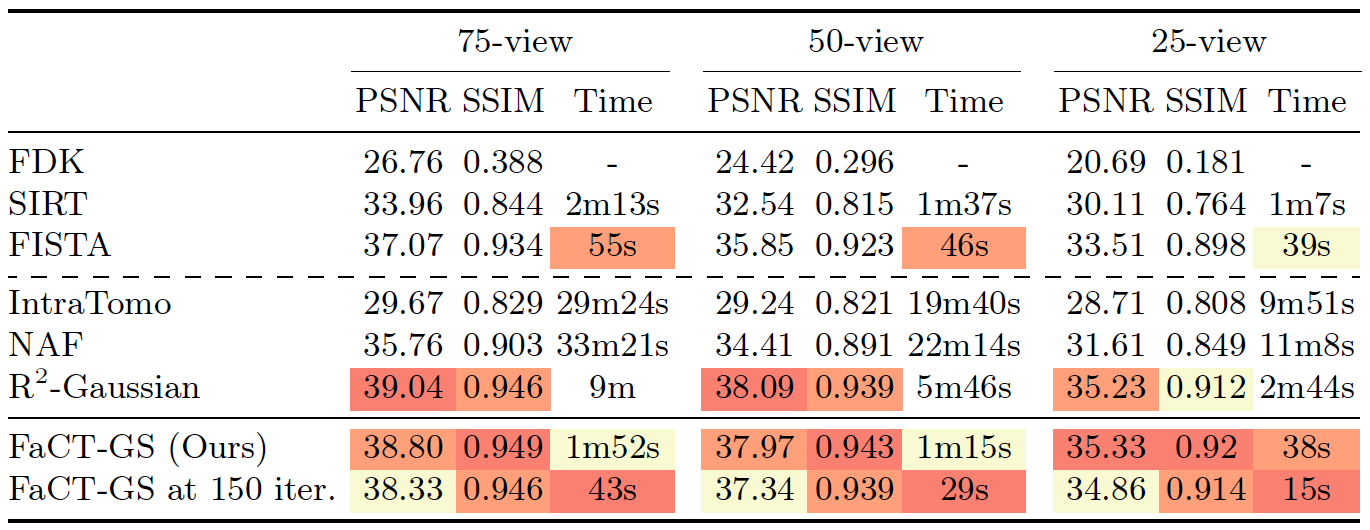
Quantitative results on the 512x512-projection dataset from R2-Gaussian. FaCT-GS is faster than its predecessors, already outperforming them in under 1 minute and being the only method to beat a well-established FISTA.
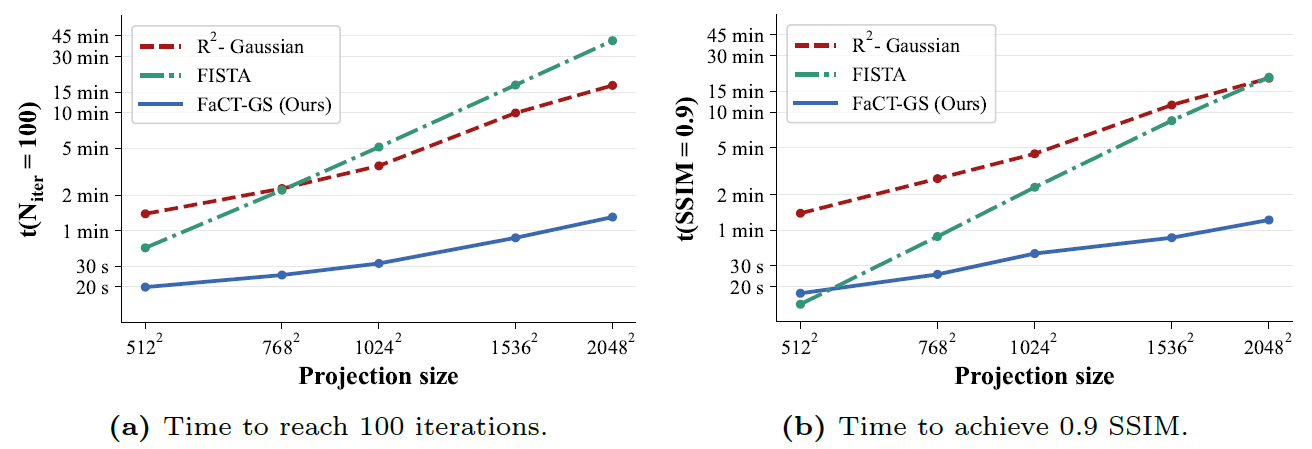
The impact of FaCT-GS is especially significant for larger projection sizes. For 2k projections, FaCT-GS needs 1 minute to reach the SSIM of 0.9, while FISTA and R2-Gaussian need 20 minutes.
Prior volume and compression
With the improved voxelization, we can rapidly fit a Gaussian representation to a prior volume, which can be used for warm-starting the optimization. The Gaussian-based model also serves as an elegant, compressed representation of the volume, especially when used as an inherent part of the reconstruction pipeline. However, even when used as a standalone compression method, it can achieve significant compression rates, rivaling the performance of JPEG.
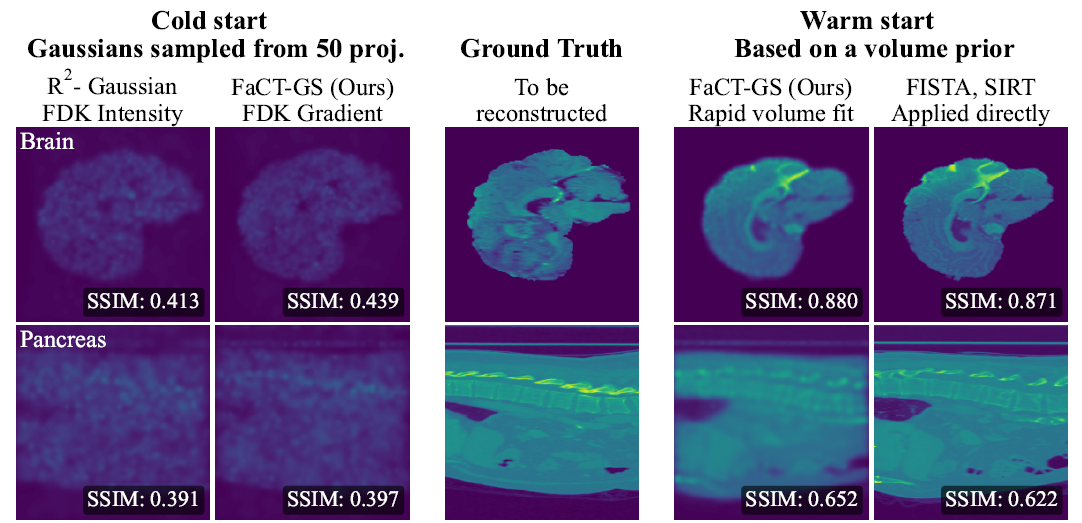
An accurate prior volume can warm-start the reconstruction process from a state much closer to the optimal solution. Fitting a Gaussian representation to a prior volume requires a few seconds, and is as effective as using the volume directly (possible in algebraic methods such as SIRT or FISTA)
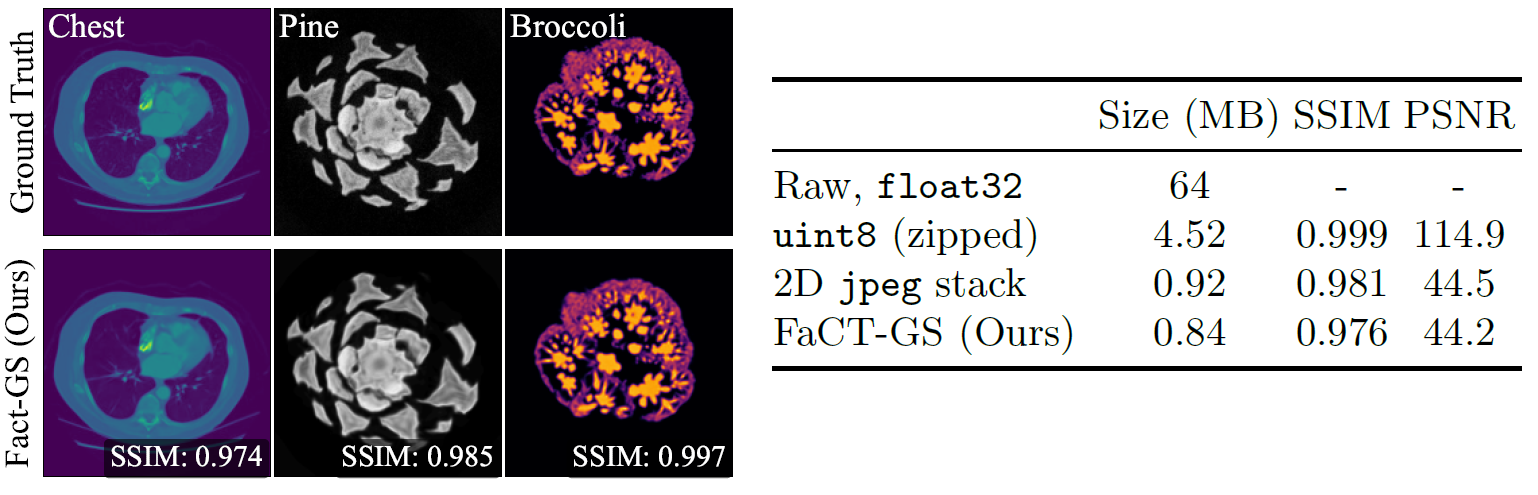
Fitting the Gaussian representation directly to a volume yields an accurate and highly compressed representation, with performance similar to JPEG. Tested on 256x256x256 volumes from the R2-Gaussian dataset.
BibTeX
@misc{pieta2026,
  title={FaCT-GS: Fast and Scalable CT Reconstruction with Gaussian Splatting},
  author={Pawel Tomasz Pieta and Rasmus Juul Pedersen and Sina Borgi and Jakob Sauer Jørgensen and Jens Wenzel Andreasen and Vedrana Andersen Dahl},
  year={2026},
  eprint={2604.01844},
  archivePrefix={arXiv},
  primaryClass={cs.CV},
  url={https://arxiv.org/abs/2604.01844},
}